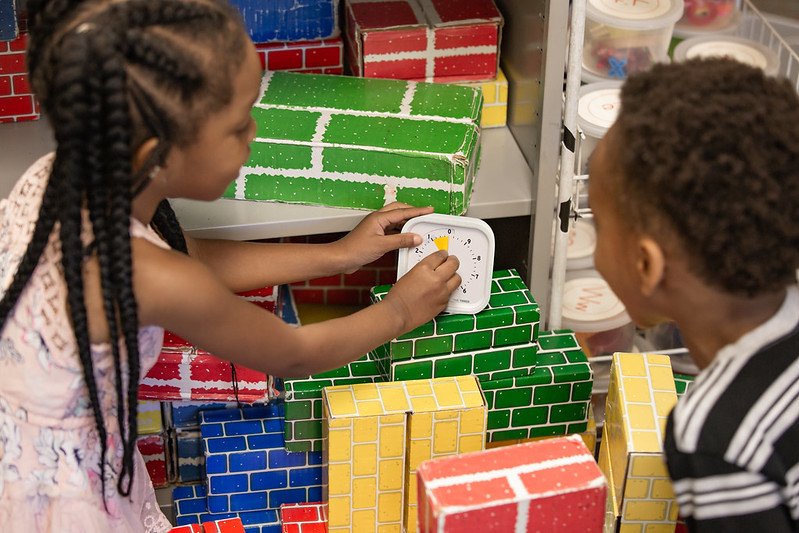
Time Concepts for Preschoolers Just Learning What ‘5 Minutes’ Means
For a number of adults, telling time is second nature. Without glancing at the clock, we may have an intuitive feel for how much time has passed since we last checked. When we do look and see it’s, for example, 7:45, our estimate may have been in the ballpark.
But for preschoolers, time is more of a mysterious abstract concept. What does “five more minutes” really mean to children who measure their day by snacks, songs, and nap time?
Much of our understanding of time must be learned when we are children. Like all early learning, the key to teaching time is making the abstract tangible. Think of math lessons where objects represent numbers.
When devising strategies to support time learning in preschool settings, Time Timer PLUS 5 Minute visual timer and Time Timer MOD 10 Minute visual timer can be useful for making five minutes something kids can see and feel, rather than just hear.
Why Preschoolers Struggle with Time
Time is a cognitive concept that develops gradually. Here are some possible reasons why:
Time Is Abstract: Time is not like a preschooler’s toy that can be touched or held. For a child, five minutes can feel like five seconds or five hours, depending on the activity—time flies when they are having fun, and crawls when they are bored. Without a visual or experiential reference, it is challenging to internalize what time really means.
Delayed Gratification Is Still Developing: Young children are impulsive so they must learn to wait their turn, pause before acting, and delay gratification. These skills develop alongside the understanding of time. When the teacher says, “In ten minutes, it’ll be naptime,” a preschooler may not yet have the mental tools to wait appropriately, instead reaching for the sleeping mat and blanket within a couple minutes.
They Don’t Understand Clocks (Yet): Though counting is related to the development of time cognition, even if a child can count to 10 or 20 that does not mean the kid can understand a digital clock or the hands on an analog one. Traditional time-telling methods are not intuitive to all early learners.
Tangible Time: Why Visual Timers Work
Children thrive on visual cues; this is especially the case for neurodiverse children such as those with autism. When learning any new concept, the more senses involved, the better. That’s where visual timers, like the Time Timer, come in.
Time Timer products visually represent the passage of time with a coloured disk that gets smaller as time ticks away. This makes time visible—an essential first step in understanding it.
Here are some reasons why visual timers are great for kids:
Visual passage of time: Kids see time “disappear” as the disk elapses.
Predictability: When a child can see how much time is left, they’re less likely to feel anxious or confused.
Encourages independence: Children learn to self-regulate their transitions and behavior with a clearer sense of what’s next, and the time limits they work within.
For preschoolers just starting their time-telling journey, shorter is better. Shorter timers like those below are specifically designed for young children or short tasks where a 60-minute countdown would be overwhelming or irrelevant.
Time Timer PLUS 5 Minute
Perfect for toddlers and early preschoolers whose activities are in short timespans.
Simple transitions: Using a timer for brushing teeth, cleanup time, and the like, can help kids get accustomed to getting things done in a timely manner. This can help with punctuality down the line.
Portable and durable: With a handle and battery operation, it’s ideal for both classrooms and home use. It can also withstand the less-than-delicate handling of small children.
Time Timer MOD 10 Minute
Stylish and compact: Great for tabletops or small spaces, this is great for the child-sized spaces of preschools.
Ideal for early learners: Ten minutes is just long enough for preschool attention spans without being too much.
Swappable cases: Children can be particular about the colors of accessories, so we offer a variety of silicone cases to choose from. In addition to the personalization, these cases are also protective.
How to Teach Time to Preschoolers
Whether you’re a teacher, therapist, or parent, there are lots of creative ways to incorporate visual timers and time-related language into preschoolers’ everyday routines.
Here are practical strategies to make time concepts stick:
Visual Timers for Transitions: Preschoolers often resist moving from playtime to clean-up, or from snack to story time. By introducing a five-minute countdown on a visual timer before transitions, you give them a visual heads-up.
Connect Time to Routines: For instance, use the Time Timer MOD 10 Minute visual timer to mark the start of morning routines. This way, children can pace themselves and develop independence.
Make Waiting Easier: Visual timers make waiting feel concrete and doable. If a child has to wait five minutes for their turn at a toy, whip out the Time Timer PLUS 5 Minute visual timer. This could potentially prevent tantrums and build emotional regulation.
Explore the Time Timer PLUS 5 Minute and MOD 10 Minute models—designed with little learners in mind.
To provide the best experiences, we use technologies like cookies to store and/or access device information. Consenting to these technologies will allow us to process data such as browsing behaviour or unique IDs on this site. Not consenting or withdrawing consent, may adversely affect certain features and functions.
Functional
Always active
The technical storage or access is strictly necessary for the legitimate purpose of enabling the use of a specific service explicitly requested by the subscriber or user, or for the sole purpose of carrying out the transmission of a communication over an electronic communications network.
Preferences
The technical storage or access is necessary for the legitimate purpose of storing preferences that are not requested by the subscriber or user.
Statistics
The technical storage or access that is used exclusively for statistical purposes.The technical storage or access that is used exclusively for anonymous statistical purposes. Without a subpoena, voluntary compliance on the part of your Internet Service Provider, or additional records from a third party, information stored or retrieved for this purpose alone cannot usually be used to identify you.
Marketing
The technical storage or access is required to create user profiles to send advertising, or to track the user on a website or across several websites for similar marketing purposes.